
Stake News Check #19 from 12/05/2025 to 12/17/2025: Presidents Félix Tshisekedi and Paul Kagame of Rwanda signed a peace agreement

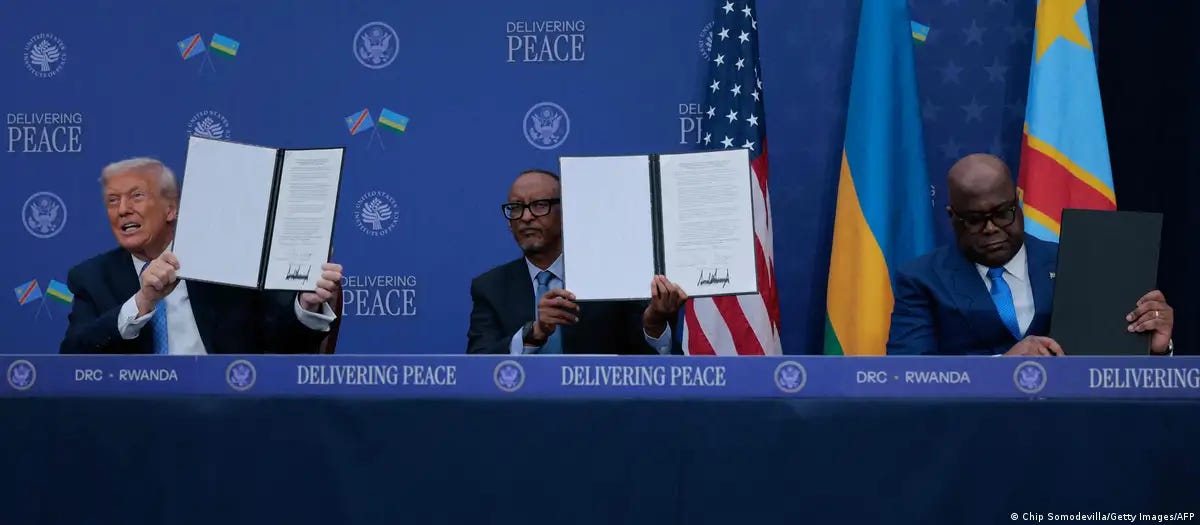
Over the past two weeks, significant political events unfolded across several African nations. In the Democratic Republic of the Congo (RDC), Presidents Félix Tshisekedi and Paul Kagame of Rwanda signed a peace agreement aimed at ending the ongoing conflict in eastern RDC. The signing ceremony took place at the newly renamed “Donald Trump Institute for Peace,” attended by Donald Trump himself. Tshisekedi expressed gratitude and hope that Rwanda would honor the agreement, emphasizing the need for a joint effort against armed groups. Kagame praised Trump’s impartiality and pragmatism, stating that while the region may not be in the headlines, Trump seized the opportunity to contribute to peace. He noted that the success of the peace agreement relies on African leaders rather than external parties [1]. Despite the agreement, hostilities have persisted, particularly involving the M23 group and RDC authorities, who continue to accuse each other of violating ceasefire terms established during previous negotiations [1].
In Tunisia, protests erupted as between 300 and 400 people marched for the fourth consecutive Saturday, demanding freedom for political prisoners and denouncing President Kaïs Saïed’s authoritarian rule. Demonstrators displayed images of opposition figures recently imprisoned for alleged conspiracies against the state. Hamma Hammami, leader of the Workers’ Party, criticized the regime for violating fundamental freedoms. The protests were organized by various human rights and political groups, underlining a growing unity among opposition factions. Wissem Sghaier from the Al Jomhouri party noted that Saïed’s repressive tactics inadvertently united diverse political groups against the regime. Organizers pledged to continue their mobilization until public liberties are restored in Tunisia [2].
In Benin, a coup attempt was thwarted as military personnel claimed control of the country. However, the Minister of Interior reassured citizens that the situation remained under control, and the government condemned the coup as a misguided mutiny. President Patrice Talon addressed the nation, promising that the coup attempt would not go unpunished and reaffirming the commitment to democratic order. The Economic Community of West African States (Ecowas) commended the rapid response of its standby force, which assisted in maintaining order during the coup attempt. The regional bloc emphasized the need for effective security cooperation to address ongoing challenges in member states [3].
The Nigerian government has confirmed the release of a Nigerian Air Force C-130 aircraft and 11 soldiers who were detained in Burkina Faso following a forced landing in Bobo Dioulasso. The aircraft had landed due to a technical issue during a ferry mission to Portugal. The release followed a diplomatic visit by Nigeria’s Foreign Affairs Minister, Yusuf Tuggar, to Ouagadougou, on the instruction of President Bola Tinubu. While Nigerian authorities described the landing as a precautionary measure in line with international aviation protocols, Mali’s junta leader Assimi Goïta condemned it as an unfriendly act, warning that Sahel states could neutralize aircraft violating their airspace[4].
In Côte d’Ivoire, President Alassane Ouattara was inaugurated for a fourth term amid a backdrop of controversy, as key opposition figures were excluded from the electoral process. Ouattara secured nearly 90% of the votes in the election with a low turnout of just over 50%. The ceremony was attended by numerous African leaders and international representatives, highlighting the significance of the event despite the absence of prominent opposition figures [5].
These developments reflect ongoing struggles for political stability and democratic governance across the continent, as leaders navigate complex challenges in their respective nations.
Sources:
[1]RDC -Rwanda
[2]Tunisia
[3] Bénin
[4] Burkina Faso - Nigeria
[5] Côte d'Ivoire